
RBI Governor Raghuram Rajan on February 2, left the key interest rate unchanged citing inflation.

India's GDP may turn positive at 1.3 per cent in the third quarter of 2020-21, having witnessed contraction in the previous two quarters due to the coronavirus pandemic, as the number of cases is falling and public spending has started rising, according to a report. The government will release the GDP numbers for the October-December quarter of the current fiscal on Friday. Projecting that the gross domestic product (GDP) may have returned to the black in the last quarter of the calendar year 2020, DBS Bank in the report said the full-year growth in real terms may be at a negative 6.8 per cent.

Analysts and economists have hailed the fiscal projections in the interim Budget, saying the lower fiscal deficit forecast shows that the government, even in an election year, is serious about fiscal consolidation and that the numbers look achievable. According to Devendra Kumar Pant, the chief economist at India Ratings, the two broad themes of the interim Budget are fiscal consolidation and stepping up focus on agriculture/rural to course correct, to some extent, the differential benefits of the ongoing economic growth that's tilted in favour of upper-income bracket/urban households. The projected fiscal deficit numbers for FY24 and FY25 suggest that the government is serious about achieving the fiscal consolidation path of 4.5 per cent fiscal deficit by FY26, and given the nominal GDP growth assumption and revenue buoyancy, the target appears plausible, Pant said in a note.

Digibank will offer only savings deposits initially, but will expand to include investments and lending in the coming months.

The trade gap was $11.66 billion in December 2015 while in September 2015 it stood at $10.16 billion

"If HR isn't responsive, it's critical to keep records of all interactions -- e-mails, dates and any conversations you had. If HR fails to help, escalate the matter to higher management or the internal complaints committee," says Smita Shetty Kapoor.

No, because year-on-year data mask a sharp upward correction in industrial growth but a rate rise could see a surge of fund flows into India and prove counter-productive

Of the three major Budget announcements related to the banking sector, privatisation of PSBs is the most audacious, says Tamal Bandyopadhyay.

The country's largest lender State Bank of India (SBI) will revamp its banking application (app) YONO and position it as a complete digital bank (DB) under a new rubric 'Only YONO' for enhancing customer experience and ease of use. The bank plans to bring in a consultant to help draw up the project plan, keeping in mind business goals for the next five years. With 54 million monthly active users (MAUs), SBI YONO has seen growth of over 35 per cent in MAUs in 2021.
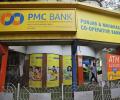
the three investors that have submitted their final bids are not commercial banks. Among the three, one is a non-banking financial company. Another distinctive feature of the revival is that PMC may lose its cooperative bank characteristic after its reconstruction.

'What we have to think about is, how to improve the efficiency of public sector banks.' 'You have to make decision-making more prudent, and free from government intervention.'

RBI may hold rates in Apr; to go for 25 bps cut by June: DBS

Foreign banks set the template in consumer banking in its infancy, but have almost vacated this booming space.

Indian banks have started exploring opportunities in the space, including lending to crypto exchanges, and accepting bitcoins as collateral, among others.

Yoga guru Baba Ramdev's Patanjali Ayurved on Wednesday made its first big acquisition when it paid Rs 4,350 crore to take over soya food brand Nutrela-maker Ruchi Soya through an insolvency process. The acquisition will help Patanjali acquire edible oil plants as also soyabean oil brands such as Mahakosh and Ruchi Gold.
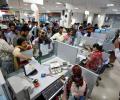
'The reason is that you may not enter the branch but you want to see it near you as it establishes trust.'

Reliance Industries Ltd, the nation's most valuable company, on Thursday said it has raised $4 billion (around Rs 30,000 crore) in debt through the largest ever foreign currency bond issuance by an Indian entity. The oil-to-telecom conglomerate plans to use the proceeds of the three tranche issues to retire existing borrowings. The issue was "nearly 3 times oversubscribed with a peak order book aggregating around $11.5 billion," the company said in a statement. This is the largest ever foreign currency bond transaction in India, eclipsing ONGC Videsh Ltd's $2.2 billion US dollar bonds issue of 2014.

India will allow three major Singapore banks to set-up wholly owned subsidiaries in the country to boost investments as part of the bilateral comprehensive economic cooperation agreement cleared by the cabinet on Monday.

In India, it is not easy to fight it out with the large banks which are nimble-footed and technology-savvy and are continuously innovating on the retail turf with newer products for customer acquisition.

Patanjali, the lone player left in contention after the exit of Adani Wilmar, had last month increased its bid value by around Rs 200 crore to Rs 4,350 crore for Ruchi Soya.
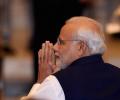
Modi has taken a slew of measures to attract investment, but he has yet to initiate steps that could help repair corporate balance sheets.

China would be an influential player in the bank

The government must set up a Bank Investment Company to shrink its role in PSBs, if we are serious about tackling the two persistent issues - lax corporate governance practices and discretionary decision-making, says Shyamal Majumdar.

Analysts at Barclays pitched for a 0.25 per cent cut to generate demand advising the central bank to throw caution to the wind.

According to Nielsen India online viewership has doubled since 2011.

Foreign banks were ahead in terms of technology, but that is no longer the case as Indian private banks steal the innovation march.

Bond issuances dipped 31.4% during January-June

British banking major HSBC on Thursday announced a consolidation exercise under which it will almost halve the number of branches in the country to 26, which will lead to 300 job losses.

UBS India, the domestic franchise of Swiss banking major UBS Group which last month surrendered its banking licence, has started laying off around 50 people, who are affected by the decision.

...but when they awaken, it's going to be overly optimistic to assume everybody will walk off the sleeping bed and come back to full life, Rajan noted.

The Indian regulatory framework forced Citi to hibernate -- contrary to the claim that it never sleeps!

The most common complaint of financial consumers is cumbersome processes, complicated products, usurious charges, and mis-selling of products, which finally don't deliver what is promised or as expect, notes Debashis Basu.

New offerings by banks are changing the way you transact.

The sudden stop in economic activity led to a sharp decline in employment-intensive sectors like construction, manufacturing and trade, hotels, transport etc.

The immediate concern for the rupee is the sharp spike in oil prices

Economists praise Das for his pragmatism and willingness to face challenges head on. And in doing so with the finesse of an able administrator.

As with TCS, most companies put their money in mutual funds, corporate bonds and bank deposits, which are losing their appeal versus government bonds in terms of both returns and safety.

The parlous state of Asia's third largest economy was reflected in the rupee's 18 per cent plunge against the dollar to all time lows since May, when signals emerged that the US Federal Reserve was considering winding down an easy money strategy that had benefitted emerging markets like India.

Irrespective of demonetisation and GST blues, IIM Lucknow has been able to successfully place their batch of 459 students.

Steps to improve governance, instill confidence in the government machinery and streamlining function across the different ministries are also important to feed the positive mood, the DBS report added.
 © 2026 Rediff.com - Advertise with us - Disclaimer - Privacy Policy - Sitemap - Feedback - About us - Terms of use - Grievances